Homeowner Resource
Why Georgia's Red Clay Soil Makes Basement Drainage Harder
☎ (678) 940-0638
24/7 dispatch if you need help right now
Anyone who's tried to dig a garden bed in this part of Georgia has run into it: that dense, reddish-orange clay that turns rock-hard when dry and sticky and slow-draining when wet. It's a defining feature of Piedmont-region soil across much of the state. It plays a bigger role in basement and crawlspace water problems than most homeowners realize.
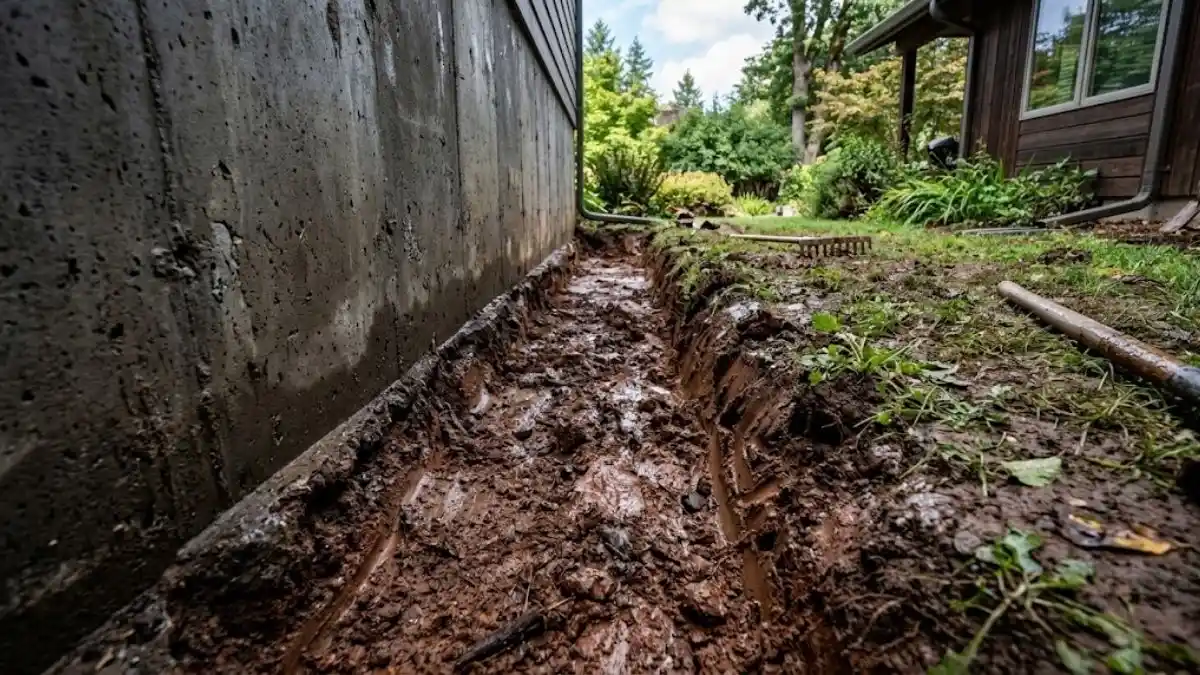
Sandy or loamy soil has larger particle gaps that let water pass through relatively quickly, moving it away from a foundation instead of letting it sit. Red clay's particles are packed much more tightly. This means water percolates through it far more slowly. During a heavy or sustained rain event, clay soil can become saturated and hold that water against whatever it's surrounding, including a home's foundation walls, for considerably longer than sandier soil would.
This is part of why hydrostatic pressure becomes a real factor for basements built into clay-heavy ground. As saturated soil pushes against foundation walls, it can force water through hairline cracks, cove joints, or areas where waterproofing has degraded over time, even without a specific storm event that would explain a sudden leak.
Homes built before modern foundation waterproofing and drainage standards became common are more likely to show this pattern than newer builds with improved vapor barriers, French drains, and sump systems designed with clay soil conditions in mind. A meaningful share of construction in Peachtree City's Aberdeen and Braelinn villages dates to the 1960s through 1980s, before those standards were in place.
If you're dealing with recurring basement dampness that seems tied to extended rain rather than a single clear leak, it's worth having it looked at rather than just running a dehumidifier and hoping it improves. Our basement water removal service specifically addresses groundwater-driven intrusion like this. Our structural drying team can confirm whether moisture has already reached framing or subfloor materials beyond what's visible on the surface.
This clay-soil drainage pattern isn't unique to any one neighborhood. We see it across Peachtree City and in older sections of Newnan as well, wherever a home's foundation and drainage design predate current best practices.
If you're considering any drainage improvement, from a simple French drain to a full regrading project, a percolation test measures how quickly water actually drains through your specific soil at your specific property. Given how much clay content can vary even within a single neighborhood in Fayette County, depending on how much topsoil was added during original construction and how the lot was originally graded, a percolation test gives contractors real data rather than a general assumption about "Georgia clay" that may not match your yard's actual drainage rate.
This is worth asking about before investing in drainage work. This is because a solution sized for typical clay soil conditions can underperform on a lot with unusually dense or unusually amended soil.