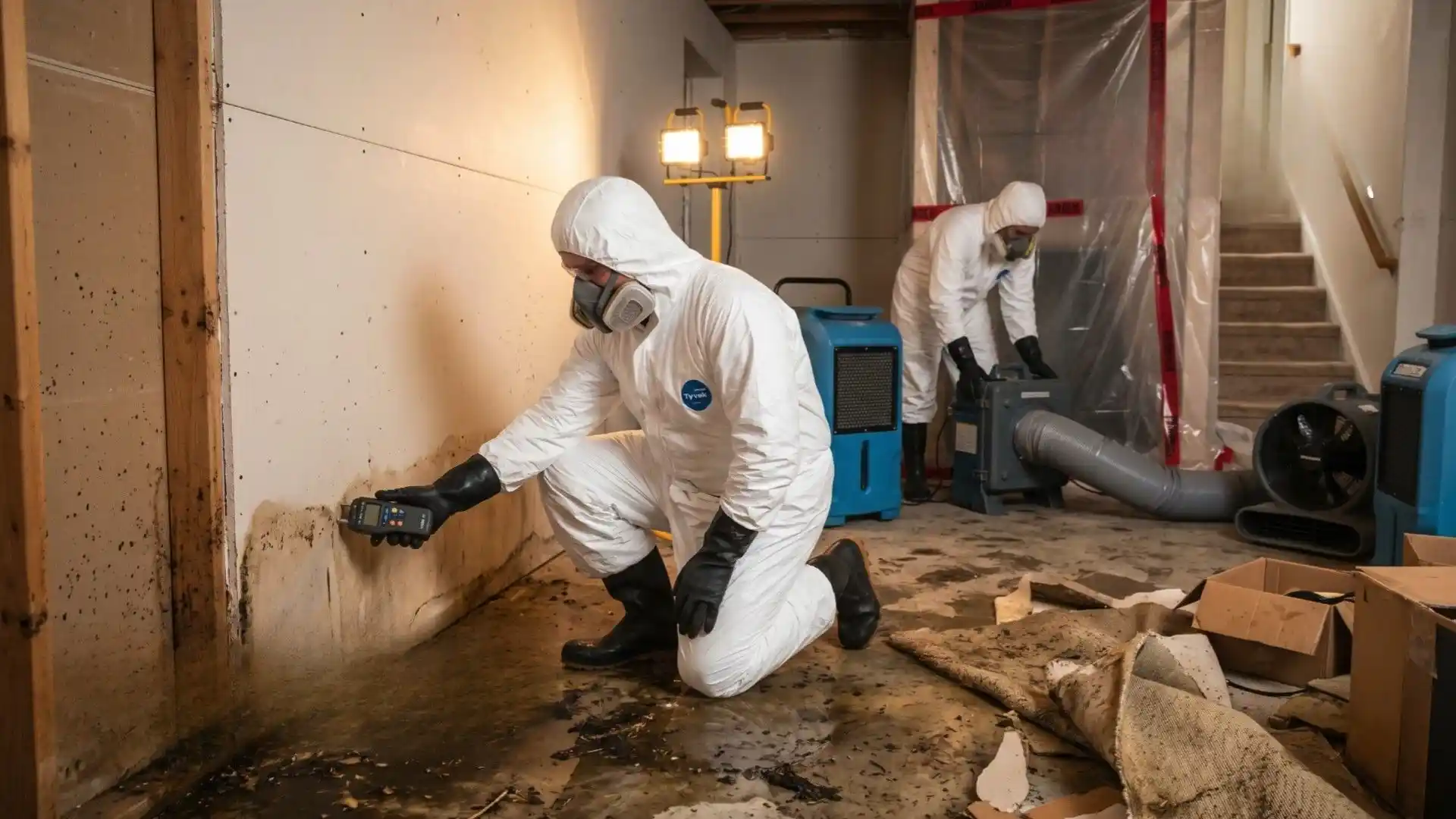
Safe extraction and sanitizing after a sewage backup, handled as a Category 3 water event from the first visit.
A sewage backup is classified as Category 3, or black water: contaminated water that carries real health risks, not just property damage. Our crews treat every sewage call with full PPE and containment from the moment we arrive, regardless of how the backup looks on the surface, because visible clarity doesn't reflect contamination level.
Fayette County includes a mix of municipal sewer connections and, in some unincorporated areas, septic systems. Backups can originate from either, a clog or line failure on the municipal side, or a septic system that's reached capacity or failed. Either way, anything the backup touched, including drywall, carpet, and porous materials, usually needs to be removed rather than cleaned, since Category 3 water isn't something you can fully sanitize out of a porous surface.
Protective equipment and containment barriers from the first visit, given the health risk involved.
Removing porous materials that came into contact with black water.
Disinfecting all surfaces and structural elements that can be salvaged.
Sewage jobs vary with how much material has to be removed under full containment. So we confirm final cost with a written, itemized assessment on arrival.
Mature tree roots seeking moisture are one of the most common causes of sewer line backups we see in Peachtree City's older, more established neighborhoods, where decades-old trees have had plenty of time to find their way into aging clay or cast-iron sewer laterals. Roots infiltrate through small cracks or joint gaps and gradually restrict flow until a backup becomes inevitable, often triggered by nothing more than a heavier-than-usual load on the line, like running the dishwasher and washing machine at the same time.
If your backup keeps recurring in the same drain or fixture, root intrusion is worth investigating with a plumber's camera inspection, since cleanup alone won't address a line that keeps narrowing over time.
It's best to keep the affected area closed off and avoid contact with the water until our crew has assessed and contained it. Category 3 water carries real health risks even in small amounts.
Generally no. Porous materials that contact Category 3 water can't be fully sanitized and are usually removed and replaced rather than cleaned.
We can often tell from the pattern and location of the backup. We'll flag it clearly, since septic issues sometimes need a septic service alongside our cleanup.